
Understanding Bloom Filter: Efficient Data Filtering Explained
A Bloom Filter is a probabilistic data structure used to test whether an element is a member of a set.
The reason it's called "probabilistic" is that the result it returns is not guaranteed to be 100% accurate; there is a certain margin of error.
The Problem: Set Membership
This is a simple problem with multiple solutions:
-
The simplest way is to iterate through every element in the set. This approach has a time complexity of O(N).
-
A better way is to store set S in RAM using a Hash Table (also known as a HashMap or HashSet). This offers near-instant, constant-time lookups (Random Access).
But what if set S is extremely large? In such cases, the cost of iterating over S becomes expensive. Furthermore, if the data doesn't fit in memory and requires continuous disk access, the cost of checking membership can be significant.
Why does the Bloom Filter shine?
This is where the Bloom Filter becomes popular, even though it might seem quite "dumb" at first glance. Its concept is somewhat similar to a Hash Table but is far more space-optimized. It quickly proves its usefulness by reducing queries to expensive-to-access resources like databases, disks, or network calls.
Applications of Bloom Filter are vast, including:
-
Databases: Google BigTable, Apache HBase, Apache Cassandra, RocksDB, and PostgreSQL use them to reduce the cost of data lookups.
-
Web Browsing: Google Chrome uses them to identify and warn users about malicious websites.
-
Content Platforms: Medium uses them to avoid recommending articles a user has already read.
-
Security: Mitigating DDoS attacks and checking for weak passwords or existing usernames/emails in a system.
-
Spell Checking: Verifying if a word exists in a dictionary.
How does a Bloom Filter work?
The core of a Bloom Filter is a bit array of M elements, all initially set to 0. Let's call this array BF.
Adding an Element
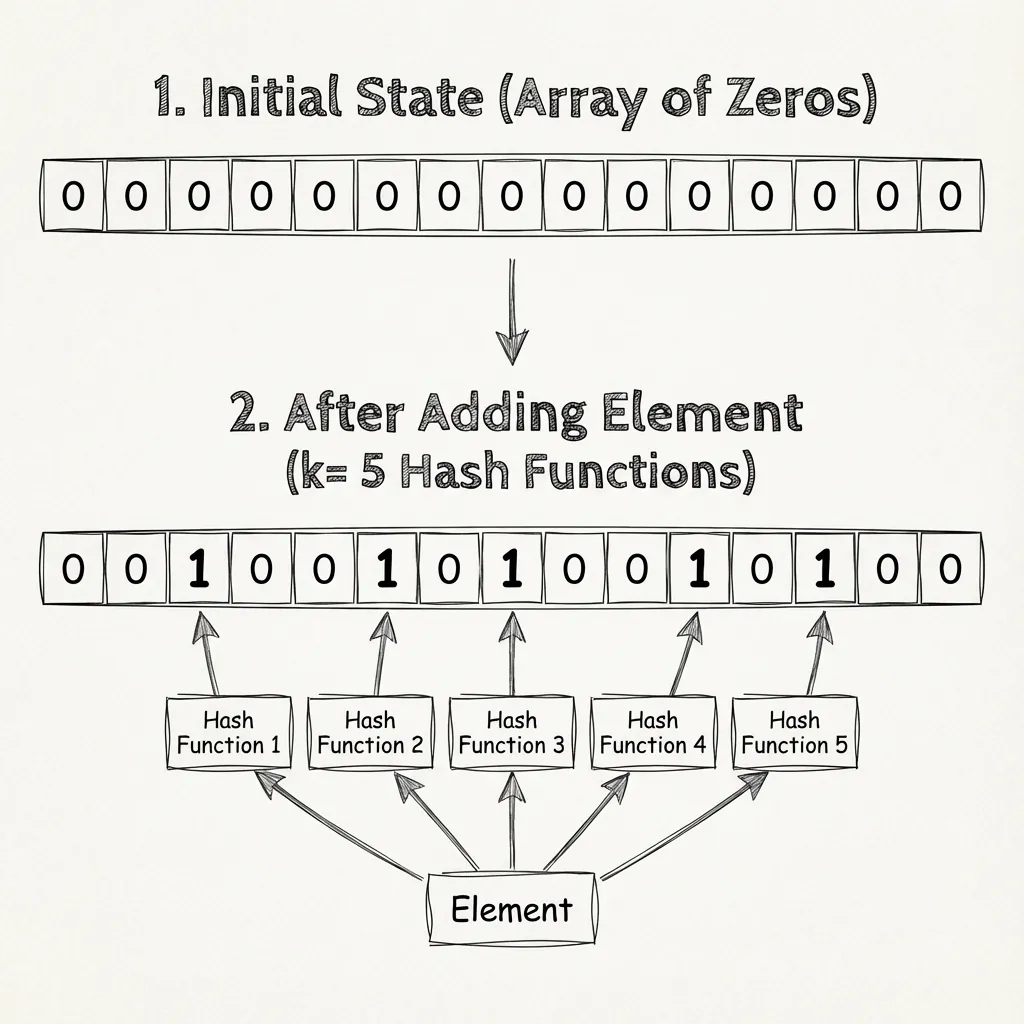
When a new element is added to the set, it is passed through k different hash functions. Each hash function outputs a position within the bit array, and that bit is set to 1.
def add(x):
    for i in range(k):
        position = hash_functions[i](x) % M
        BF[position] = 1
The hash functions should be independent and produce uniformly distributed outputs. They should also be fast and resource-efficient (which is why cryptographic hash functions like SHA are less commonly used). Examples of hash functions used are murmur, fnv, etc.
Note on Hash Functions:
We typically use multiple (k) independent and fast hash functions (like murmur or fnv) to ensure a uniform distribution. Instead of finding k distinct algorithms, a technique called Double Hashing can be used. With just two independent hash functions, we can generate k hash values efficiently.
def add(x):
    a = hash_function1(x)
    b = hash_function2(x)
    for i in range(k):
        position = (a + i * b) % M
        BF[position] = 1
When we add more elements, we repeat the same process. The bit we set might already be 1 (which is okay).
Checking for an Element
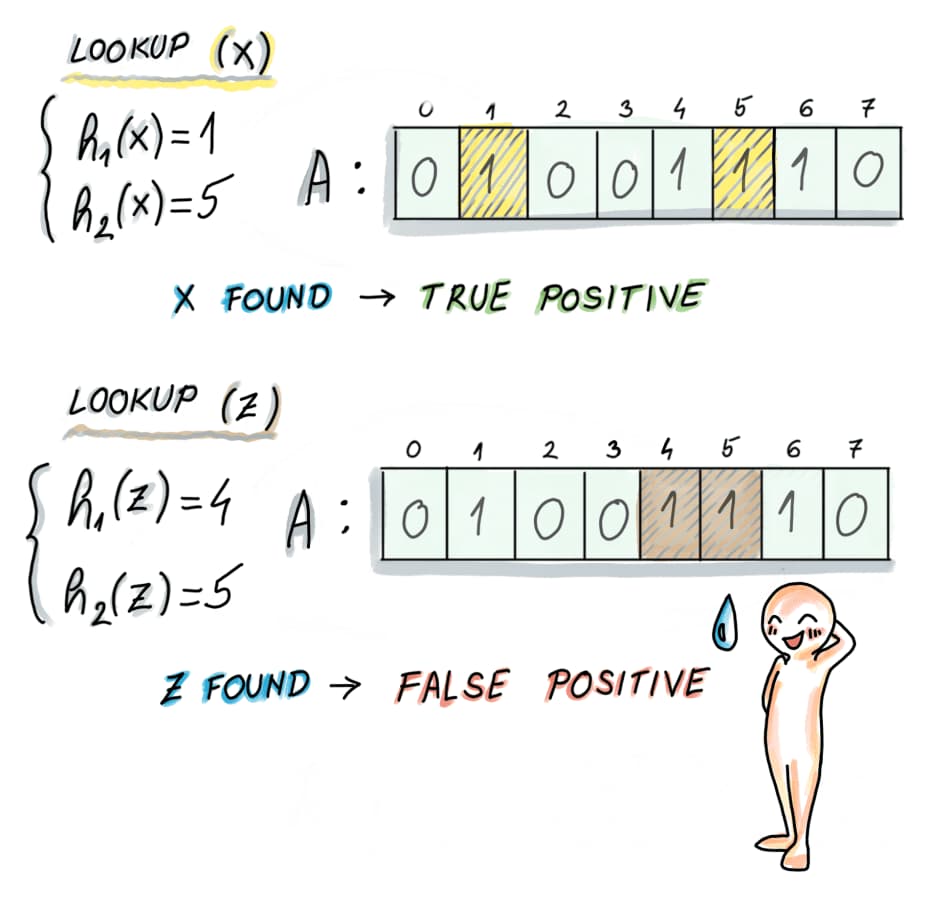
To check if a value x is in the set, we pass it through the same k hash functions and check the bits at the resulting positions.
def check(x):
    a = hash_function1(x)
    b = hash_function2(x)
    for i in range(k):
        position = (a + i * b) % M
        if BF[position] == 0:
            return False
    return True # Means "possibly in S"
Key Observations:
-
If any of the checked bits is 0, then x is definitely not in the set S.
-
If all the checked bits are 1, then x is probably in S. However, there's a chance it's a false positive (the bits were set by other elements).
-
The time complexity for both insertion and lookup is O(k), which is constant and independent of the set size N.
Let's clarify the terminology:
-
True Positive: x is in S and the Bloom filter returns True.
-
False Positive: x is not in S, but the Bloom filter returns True.
-
True Negative: x is not in S and the Bloom filter returns False.
-
False Negative: x is in S, but the Bloom filter returns False. Note: Standard Bloom filter have zero false negatives.
Despite its simplicity, the Bloom filter's false positive rate can be surprisingly low. The following chart illustrates how the rate decreases as the size of the bit array (M) and the number of hash functions (k) increase.

The False Positive Probability
The probability of a false positive for a Bloom filter is given by the formula:
You can plug in the expected number of elements (N) for your application and experiment with different values of M and k to estimate the false positive probability.
For those curious about the derivation, let's break it down. It's simpler than it looks!
Let’s consider a Bloom filter with and hash functions. We imagine dividing the main array into segments (each of length ).
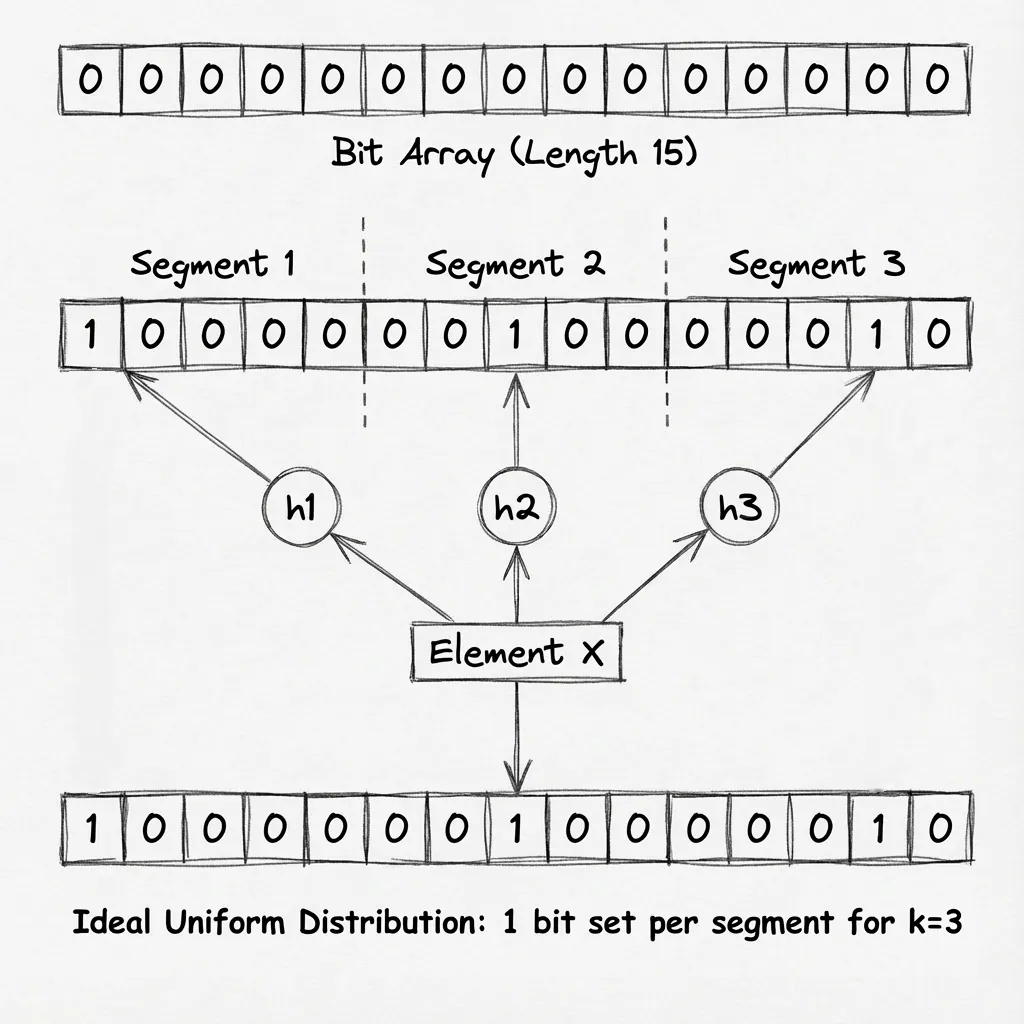
A characteristic of a good hash function is that the resulting bit distribution is close to uniform randomness. Hence, we expect that, for every element inserted, only one bit in the segment will be set.
Therefore, the probability of any given bit in a segment being set to 1 following the insertion of one element is . More generally, this probability is .
-
Therefore, the probability that a specific bit is not set is .
-
After inserting N elements, the probability that a specific bit is still 0 is:
-
Therefore, according to the Taylor series approximation, the probability that a specific bit has been set to 1 is:
For an element not in the set to yield a false positive, all k of its hash positions must be 1. The probability of this happening is:
Based on , we can work backward to find the threshold number of elements N at which the Bloom filter becomes saturated and the false positive rate rises too high. With M and P fixed, the optimal N is approximately:
is achieved when . Substituting into , we find the optimal number of hash functions is:
Practical Example: The Power of 32kB
Let's allocate about 32kB of memory (M = 262,144 bits) and see the results for different false positive probabilities (P). The numbers are impressive for such a small memory footprint!
| 0.1% | 0.01% | 0.001% | 0.0001% | |
|---|---|---|---|---|
| 10 | 14 | 17 | 20 | |
| 18,232 | 13,674 | 10,939 | 9,116 |
Important Considerations
-
Deletion: Traditional Bloom Filter do not support deletion. However, variants like the Counting Bloom Filter and Cuckoo Filter have been developed to solve this problem.
-
Data Storage: A Bloom Filter does not store the actual elements. It only tests for membership. Therefore, a separate, definitive data store is still required to retrieve the elements themselves (which is why it's called a "filter").
-
Scaling: What happens when the set S grows beyond the warning threshold N? One method is to allocate a new Bloom Filter with a stricter false positive rate (e.g., for ). New elements are inserted into this new filter. When checking for membership, you check all filters sequentially. If an element is not found in any filter, it is definitely not in S.
Related posts

The Birthday Paradox Explained: Real-World Applications
Explore the surprising mathematics of the Birthday Paradox and its real-world applications, from party tricks to cybersecurity essentials